
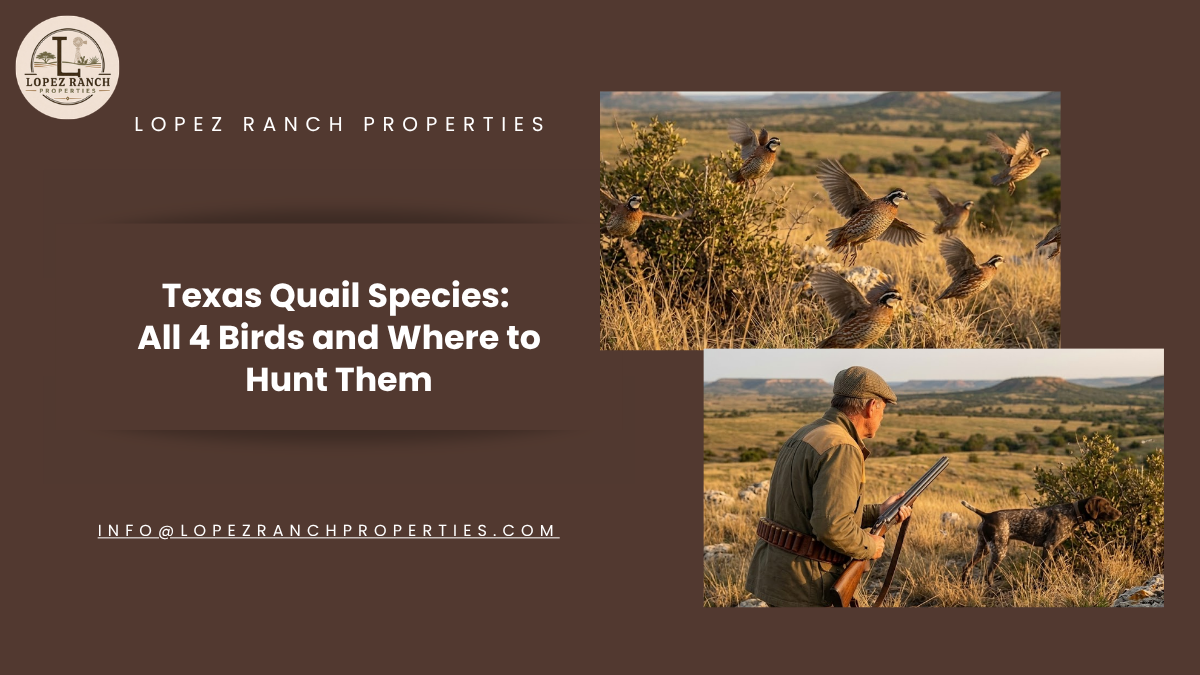
Four species live in Texas. Three of them you can hunt. Here’s how to tell them apart, what each one does when your dog gets close, and where you’ll actually find them.
Written by Pete and Eliseo, hunting guides at Lopez Ranch Properties. Both grew up on the ranch, went to school in Zapata, and graduated from Texas A&M University–Kingsville.
Short answer: Texas has four quail species. Northern bobwhite, scaled quail (most people call them blue quail), Gambel’s quail, and Montezuma quail. You can hunt the first three. You can’t hunt Montezuma. Every one of them runs, holds, and flushes differently, so knowing which bird you’re on changes how you work your dogs and where you put your feet.
Ask most hunters to name a quail, and you’ll get one answer. Bobwhite. Fair enough, it’s a fine bird to build a life around. But head out west, or plan your first trip past the Pecos, and you’ll run into birds that don’t look like the one you grew up on and sure don’t act like it.
So here’s the whole roster, what each bird does when the pressure’s on, and where in Texas you’ll find them.
Quail species or quail breeds? They are not the same thing
Quick note before we get going, because searching for quail online turns up a lot of noise.
Species are wild birds. Bobwhite, scaled, Gambel’s, Montezuma. They evolved here, they live here, and they’re what you hunt.
Breeds are domesticated. Coturnix are the common ones, raised in backyard pens for eggs and meat. That’s a farm bird, not a game bird, and you’ll never flush one out of a sendero.
People use the words interchangeably online, but they’re not the same thing. If you’re reading about quail varieties and the article starts on square footage per bird and laying rates, you’ve wandered onto the poultry side of the internet. Everything below is about wild birds.
The 4 quail species found in Texas
Texas has more quail country than any other state, and the four species carve it up by habitat. You can drive from bobwhite ground to blue quail ground in an afternoon. Get up into the mountains of the Trans-Pecos, and you’re looking at a bird most Texans have never laid eyes on.
Northern bobwhite
The bird everybody means when they say quail hunting.
- What you are looking at: Round, reddish-brown, chunky, no head plume. Roosters wear a bold white throat patch and eye stripe. Hens have the same markings in buff. Ten inches, maybe six ounces. Nine times out of ten you’ll hear one before you see it, because that two-note whistle carries a long way on a still morning.
- Where they live: Just about everywhere east of the Pecos, which covers most of the state. The two strongholds are the Rolling Plains up around Knox, King, Stonewall and Cottle counties, and the South Texas brush country. Both hold good numbers when the rain cooperates.
- What they do when you get close: They hold. That’s the whole reason Bobwhite Hunting built the tradition it did. A covey will sit tight and let a pointing dog lock up on them, which buys you time to walk in, set your feet, and be ready. And when they go, they go. A covey rise at ten feet will rattle you the first hundred times, I promise. They don’t fly far, though. Most coveys put down again inside a quarter mile, and working the singles afterward is half the fun.
Where coveys hold in the South Texas brush
On this ranch, coveys live on edges. Sendero borders and ranch roads, where open feeding ground runs up against heavy native brush, hold most of the birds. They work the open for seed and insects and keep blackbrush, mesquite, grass clumps, and prickly pear within a short sprint. Tanks and troughs are worth walking to, for the water and for whatever has grown up around it.
The pattern moves as the season goes. In November birds spread out across grassy openings, grazed strips and brush edges, because food and cover are everywhere and they can afford to be spread thin. By February the country has thinned and dried out, and coveys pull in tight to the heavy brush lines and prickly pear where the loafing and escape cover is dependable.
Day to day it shifts with temperature, wind, moisture, and whatever there is to eat. Knowing when a piece of country has gone quiet, and it’s time to move to fresh ground is most of what a good guide does.
Taking somebody on their first quail hunt? This is the bird. It forgives the most.
Scaled quail, or blue quail
Two names, same bird, and the one that’ll teach you the most about your dog.
- What you are looking at: Blue-gray all over, with a feather pattern that looks like fish scales laid across the breast and back. A little bigger than a bobwhite, eleven or twelve inches. The giveaway is that white-tipped crest on the head, which is why old-timers call them cottontops. Once you’ve seen one, you’ll never mistake it for a bobwhite.
- Where they live: West and southwest Texas, out into the Trans-Pecos, and down through parts of the South Texas brush country where the ground opens up. They like it drier and more open than bobwhites do. Thin brush, prickly pear, caliche flats, room to move.
- What they do when you get close: They run. That’s the one thing to understand about blue quail, and it’s what frustrates hunters coming off a bobwhite background. A covey hears you coming and just starts jogging, and they cover ground faster than you’d believe on those short legs. They’ll run a dog’s nose right out from under it, cut through three patches of cover, and flush wild at sixty yards while you’re still trying to figure out where they went.
Two things help. Move fast and don’t give them time to get organized. And if you can push them toward thicker cover instead of open ground, they’ll tuck in and sit rather than keep running. A bird that commits to cover is a bird that’ll hold long enough for a point.
Lopez Ranch holds both species. Bobwhite and scaled quail, both entirely wild, across more than 13,000 acres. Bobwhites turn up along brush lines, sendero edges, and mixed cover. Blues favor the more open, arid country. Bobwhite is still the primary bird, but you can run into both in the same day, and there aren’t many South Texas operations that can say that.
Blue quail humble people. That’s exactly why they’re worth hunting.
Gambel’s quail
- What you are looking at: That curved black topknot bobbing off the forehead gives it away every time. Roosters carry a black face outlined in white, a rusty crown, and a black patch on a pale belly. They look almost painted.
- Where they live: Far West Texas only, mostly the Trans-Pecos along river corridors and desert washes. This is the edge of their range. Most of the Gambel’s population sits in Arizona and New Mexico, so if you want a Texas bird you’re driving a long way for it.
- What they do when you get close: Like their scaled cousins, they’d rather run than fly, and they’ll use every wash and mesquite thicket to do it. Hunt the water. Out in desert country birds build their day around cover and moisture, and washes give them both. Early morning, before the sun pushes them into heavy brush, is your window.
Montezuma quail
The one you can look for but can’t shoot.
- What you are looking at: The strangest-looking quail in North America, no contest. Roosters wear a black and white harlequin face pattern that looks like a mask, with a rounded buff crest and a chestnut belly speckled white. You’ll hear them called harlequin quail, painted quail, fool quail, and Mearns quail. Same bird every time.
- Where they live: Trans-Pecos, plus a few remnant populations in the Edwards Plateau, up in oak and grass country at higher elevation. Their numbers here have never been strong.
- The important part: There’s no open season on Montezuma quail in Texas. Texas Parks and Wildlife lists them as a game bird because other states hunt them, but the season here is closed, and the bird is designated a Species of Greatest Conservation Need. Arizona and New Mexico both run Mearns seasons. Texas doesn’t.
Learn what one looks like anyway. You might put one up in the Davis Mountains someday, and the last thing you want is to swing on a bird you can’t legally take.
Texas quail species at a glance
| Species | Where in Texas | Habitat | Key ID | Under pressure | Huntable |
|---|---|---|---|---|---|
| Northern bobwhite | East of the Pecos, Rolling Plains and South Texas | Brush, native grass, cropland edges | Reddish brown, no plume, white throat | Holds tight, explosive rise, resettles within a quarter mile | Yes |
| Scaled (blue) | West and southwest Texas, parts of South Texas | Arid open brush, prickly pear, caliche | Blue gray, scaled pattern, white-tipped crest | Runs first, flushes wild, holds better in thick cover | Yes |
| Gambel’s | Far West Texas, Trans-Pecos | Desert washes, mesquite, river corridors | Curved black topknot, black belly patch | Runs, uses washes to escape | Yes |
| Montezuma | Trans-Pecos, Edwards Plateau remnants | Oak grass slopes, higher elevation | Harlequin face, chestnut belly | Sits motionless, relies on camouflage | No, closed season |
The two species Texas does not have
For the full picture, North America has six huntable quail species, and Texas is missing two of them.
California quail, sometimes called valley quail, look a lot like Gambel’s with that same curved topknot, but they wear a scaled belly and a gray chest. West Coast bird, thickest in California, Oregon, and Washington.
Mountain quail are the biggest of the six and carry a long, straight head plume instead of a curved one. They live in steep, brushy high country in the Pacific Northwest, and most people will tell you they’re the hardest of the six to hunt. That’s mostly the terrain talking.
Quail Hunting with Dogs: Pointers, Flushers and What Actually Matters
You can hunt quail without a dog. You’ll just find fewer birds, lose more of the ones you hit, and do a lot more walking for the privilege.
Pointing dogs vs flushing dogs for quail
Pointing dogs are the classic quail answer, and on bobwhite they’re hard to beat. A dog that locks up and holds gives you the one thing a covey rise takes away, and that’s time. English pointers, Brittanys, German shorthairs, setters, they all do this work well. Flushing dogs earn their keep in thick cover and on running birds, as long as they stay in range and sit on the rise.
What a full string looks like on a South Texas hunt
A typical rig at Lopez Ranch carries eight to ten English Pointers, plus two more dogs, either English Cockers or Labrador Retrievers. The pointers have the range and endurance to cover big open country, senderos, and mixed brush and actually find coveys. The cockers and Labs come in for flushing and retrieving, which matters most once birds are down in the thick stuff.
Carrying that many isn’t showing off. This ground goes from open field to heavy blackbrush, mesquite, and prickly pear, and dogs get used up. Rotating fresh dogs through the day means there’s always a good nose working, whatever the cover turns into.
What makes a good quail dog on running birds
A dog that can’t handle a moving covey is going to have a rough day on blue quail. What you want is a nose good enough to trail birds that are actively walking away, and enough discipline not to bust the covey out of range. That’s training more than breeding.
Why a good nose matters after the shot
Here’s what nobody tells new hunters. A good nose matters as much after the shot as before it. Winged quail run hard, and they run straight into the thickest thing they can find. Plenty of birds that look stone dead in the air end up costing your dog a hundred-yard track. Be patient on the retrieve, mark your birds, and don’t call a dog off too early.
Gun safety on a covey rise
Quail break in every direction at once, including straight at you and past your ear. That’s how people get hurt and how dogs pick up pellets. Know where every hunter and every dog is before the covey goes, pick your lane, and let the birds behind you go.
Where to hunt quail in Texas
Three regions carry most of the quail hunting in this state.
The Rolling Plains. Bobwhite heartland. The country around Knox, King, Stonewall, Fisher, Cottle, and Motley counties mixes native bunchgrass, mesquite, and old CRP fields into about as good a bobwhite habitat as you’ll find anywhere. When the rain shows up, so do the birds.
South Texas brush country. The other bobwhite stronghold, and it holds scaled quail too where the ground opens up. Native brush, senderos, prickly pear, and grazing strips give quail the cover mix they need, thick enough to hide in and open enough underneath to walk through. Bird numbers here ride on summer rainfall more than anything else.
The Trans-Pecos. Scaled and Gambel’s country, plus the Montezuma you can’t hunt. Big, dry, empty, and beautiful.
Now here’s the part that decides your season. About 95% of Texas is privately owned. That’s the single biggest difference between hunting quail here and hunting them in Arizona or New Mexico, where you can park on public desert and start walking. In Texas, the birds are mostly behind a gate. There is public opportunity through the state’s public hunting lands and the annual permit draw, but it’s limited, and it takes pressure.
So for most hunters, quail hunting in Texas comes down to access. A lease, an invitation, or a booked hunt on a private ranch. It’s not that Texas is short on birds. It’s that you need permission to get to them.
Looking at the southern end of the state? Lopez Ranch runs guided wild quail hunts on private South Texas brush country, and you don’t need a lease to get on it.

Wild quail or pen-raised birds
If you’re booking a hunt, ask this before you put money down. It’s also the question most hunters don’t think to ask until they’re standing in a field wondering why the birds are acting so strange.
Texas lets landowners release pen-reared, banded quail under a Private Bird Hunting Area license. Birds released that way come with no season and no bag limit, so you can shoot them year-round in any number. That’s a legal, licensed operation, and for some folks it’s exactly what they want. Guaranteed birds, no bad days, a good way to start a young dog or bring along a new hunter.
But it’s not the same hunt.
Wild birds sit differently. They flush at the wrong moment, run when you want them to hold, and use cover in ways a pen bird never learned. A wild covey that’s already been hunted twice this season will bust at sixty yards and leave your dog looking foolish. Pen-raised birds tend to hold too long, fly short, and sometimes don’t fly at all.
There’s a habitat argument here too. Wild birds exist because somebody managed the land for them. Brush structure, grazing, water, and some restraint about how hard the ground gets hunted. A place with a healthy wild population is telling you something about how it’s been run.
What managing for wild quail actually looks like
At Lopez Ranch it comes down to three things. Keep water dependable, keep native brush and grass intact, and keep travel corridors open. Stock tanks and troughs get maintained. Overly dense brush gets selectively sprayed. Senderos stay open while the cover alongside them, the stuff quail need for nesting and shade, stays where it is.
Cattle do a fair amount of the work. Rotational grazing puts grazed strips through the ranch alongside heavier grass and brush, and that edge is exactly what quail want. They can feed and travel in the open without ever getting far from nesting and escape cover.
Buffelgrass is the part people argue about, and it’s worth being straight about it. Buffel has carried the cattle operation here for generations. Portions of those fields get cut every few years for round bales that keep the herd going through drought. Cutting and rotational grazing also stop it from going uniformly thick, which is the real problem with buffel where birds are concerned. Broken up, it stays usable country.
And with more than 13,000 acres and a deliberately limited calendar, hunted areas get rotated and rested through the season.
Neither kind of hunt is wrong. Just know which one you’re buying.
Planning a South Texas quail hunt
If you’re putting together a trip around wild birds, here’s what to check before you book.
Are the birds wild?
Just ask. It’s a fair question, and any honest operation will give you a straight answer.
How much country, and how hard is it hunted?
Acreage matters, but pressure matters more. A ranch that runs a controlled calendar and rests its ground will hunt better in February than one that books every weekend from opening day.
Are dogs and guides included?
A guide who knows where the coveys hold on that particular ground is worth more than anything else you’re paying for. Birds use the same cover year after year, and somebody who’s watched that pattern for a decade will find you birds you’d have walked right past.
What is the group setup?
Most quail operations run minimums, and honestly hunts work better with small groups anyway. Fewer guns, safer rises, better dog work.
Pete and Eliseo run the dove and quail hunts at Lopez Ranch. Both grew up on this ranch, went to school in Zapata, and finished at Texas A&M–Kingsville. They’ve spent their lives on these roads, senderos, water sources, and brush patterns, and they know how birds shift when the weather turns. That isn’t something you pick up off a map or in a season or two.
The ranch runs wild quail hunts on more than 13,000 acres of private South Texas brush country, holding both wild bobwhite and scaled quail. No pen-raised releases, walking hunts behind a full string of pointers and flushing dogs, and a controlled calendar that keeps the pressure low. Groups of 4 hunters and up, with lodging and meals if you want to make a weekend of it.
Nobody here is going to promise you a covey count. These are wild birds, and the day gets decided by weather, scenting conditions, and where the birds have moved to. What the ranch will tell you is that coveys turn up regularly during ordinary ranch work, with nobody scouting and no dogs on the ground, which is about the most honest way there is to judge whether a place holds birds.
The ranch has been in the same family for five generations, and the land’s been managed with birds in mind for most of that time.
Planning a fall trip? You can pair quail with South Texas dove hunts earlier in the season.

Conclusion
Four quail species live in Texas, and three of them are fair game. Bobwhites hold for dogs and forgive your mistakes. Blue quail run, and they’ll expose every weakness in your dog work. Gambels mean a trip out west. Montezumas, you look at and leave alone.
Learn to tell them apart, match your approach to the bird in front of you, and find good ground with wild birds on it. The rest is just walking.
Frequently Asked Questions
1. How many quail species are in Texas?
Four. Northern bobwhite, scaled quail (blue quail), Gambel’s quail, and Montezuma quail. Only the first three have an open season.
2. Can you hunt Montezuma quail in Texas?
No. The season is closed statewide and has been for years, so if you put one up you leave it alone. If you want to hunt Mearns, southeastern Arizona is where most people go.
3. Are blue quail and scaled quail the same bird?
Yes. Blue quail is just the common nickname for the scaled quail, and it comes from the bluish gray coloring. You’ll also hear them called cottontops, after that white-tipped crest.
4. What is the difference between bobwhite and scaled quail?
Bobwhites are reddish brown with no head plume, like brush and grassland with cropland edges, and hold tight for pointing dogs before an explosive covey rise. Scaled quail are blue-gray with a scale pattern and a white-tipped crest, prefer drier open country, and would rather run than fly.
5. Can you hunt both bobwhite and blue quail on the same property?
In parts of South Texas, yes. Where brush country gives way to more open, arid ground, the two species overlap. Lopez Ranch holds both across its 13,000 acres, with bobwhite as the primary bird and scaled quail in the opener country.
6. Are quail breeds and quail species the same thing?
No. Species means wild birds like the bobwhite or scaled quail. Breed means domesticated birds like Coturnix quail, which are raised in captivity for eggs and meat and aren’t hunted.
7. What is the best dog for quail hunting?
Pointing breeds are the traditional choice, especially on bobwhite, because they hold birds until you’re in position. English Pointers do the long-range work of finding coveys in big country. Flushing breeds like English Cockers and Labrador Retrievers are worth having along for thick cover and for retrieving. What matters most is a strong nose, steadiness on the rise, and enough discipline to trail running birds without busting the covey.
8. Where is the best quail hunting in Texas?
The Rolling Plains and the South Texas brush country give you the most consistent bobwhite hunting, with scaled quail out in the western and southwestern parts of the state. But since roughly 95% of Texas is privately owned, getting access to a ranch or booking a guided hunt matters more than picking the right region.